

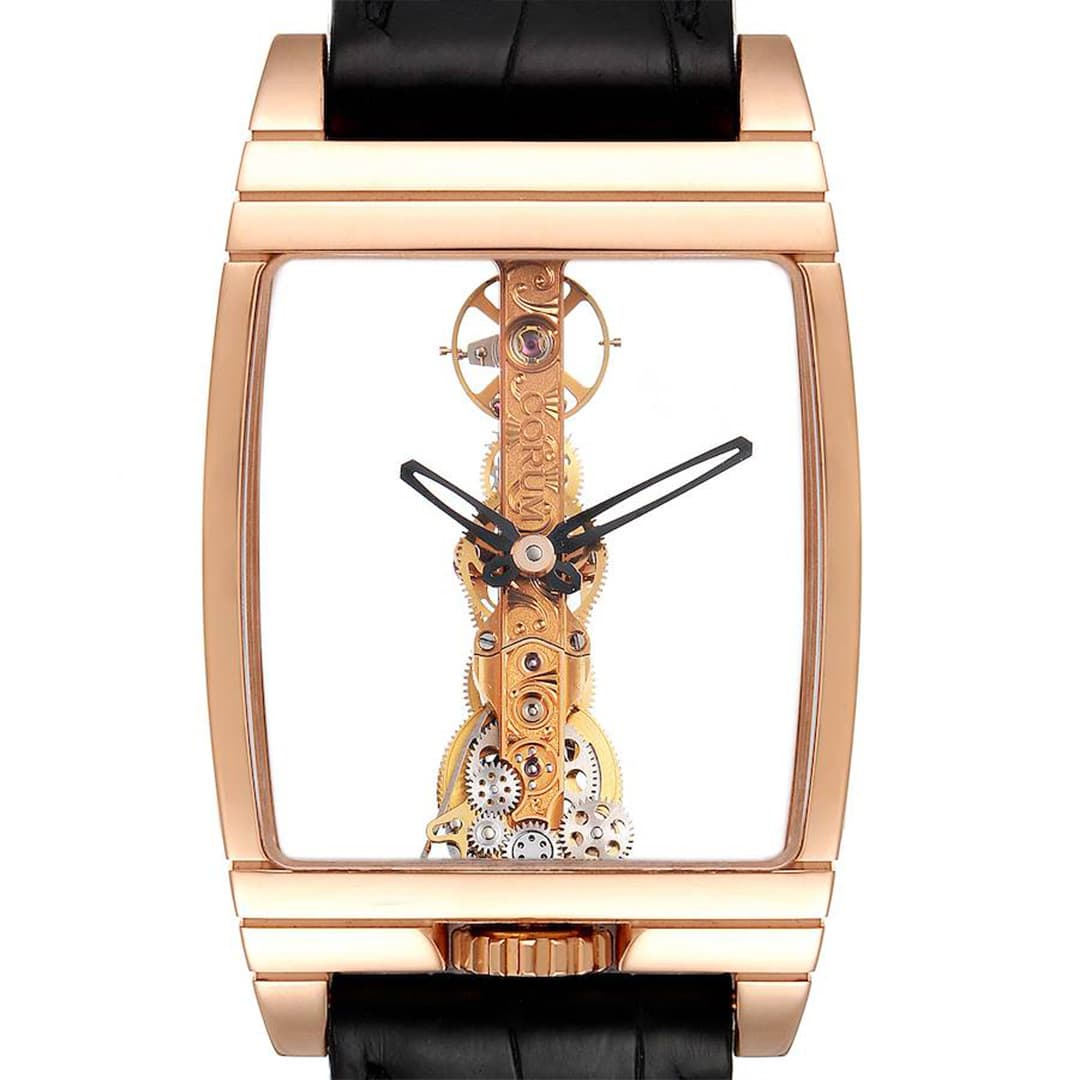
The Golden Bridge – A Clear Icon
September 29, 2025
Corum introduced the Golden Bridge in 1980, a revolutionary timepiece designed by Vincent Calabrese that showcased mechanical watch movements through a transparent design. This innovation became particularly significant during the quartz crisis of the 1980s, when the very survival of mechanical watchmaking was in question.
Accidental Inspiration
Calabrese's concept emerged unexpectedly when a customer requested repairs to a damaged Breguet minute repeater. The customer noted that "no one sees the movement anyway," which inspired Calabrese to create a watch where the movement itself becomes the focal point rather than the case or dial.
It was a radical departure from conventional thinking — rather than hiding the mechanical heart of the watch behind a decorative face, Calabrese asked: what if the movement is the decoration?
Unveiling a Masterpiece
Calabrese spent years developing a unique 45-component linear movement with 18-carat gold bridges and main plate. He unveiled this creation at the 1977 Geneva International Inventors' Show and received a gold medal for his innovation.
René Bannwart, Corum's founder, recognized its potential immediately. The pairing of Calabrese's vision with Corum's manufacturing capability would produce one of the most distinctive watches in horological history.
The Birth of an Icon
The first Golden Bridge debuted at the 1980 Basel Fair, establishing Corum's reputation for innovative watchmaking during an era when quartz technology dominated the industry. The watch proved that mechanical timepieces could compete not through precision alone, but through artistry and emotional appeal.
A Legacy of Aesthetic and Technical Revolution
The watch exemplifies both technical achievement and aesthetic design through its singular linear "baguette" movement. Over the decades, Corum has continued evolving the design with automatic versions, various case shapes, and decorative elements including hand-engraved gold and enamel work.
The Golden Bridge remains a testament to what happens when a watchmaker dares to turn convention inside out — literally making the invisible visible, and transforming mechanical necessity into pure art.